


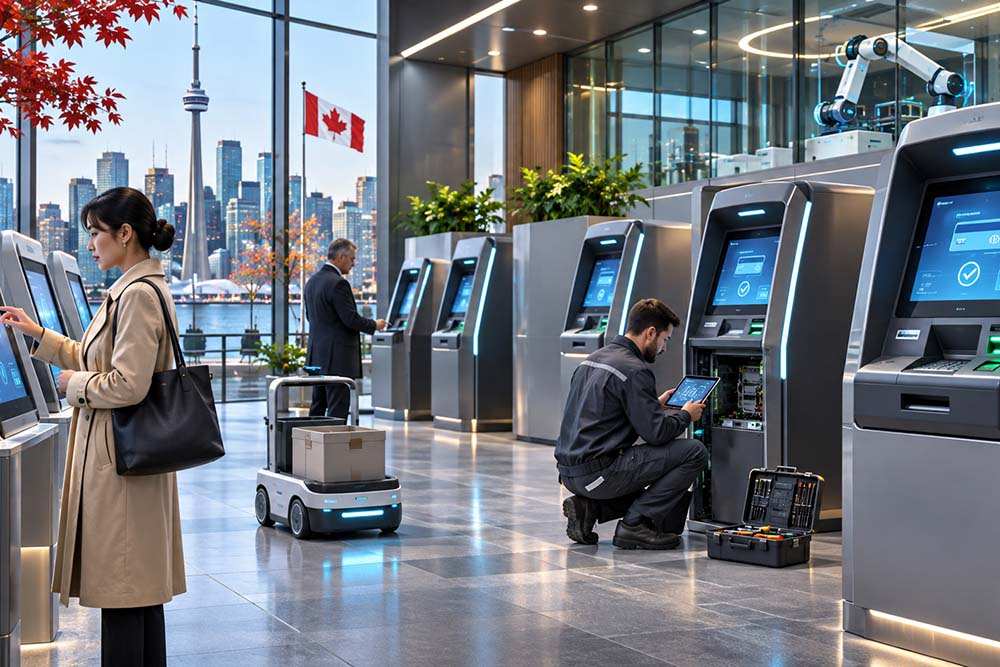


ATMs may appear to be simple self-service machines, but reliable cash access depends on a complex network of skilled people. Across Canada, operators are balancing service expectations with recruiting challenges and new monitoring tools. The opportunity is not to remove the workforce from the equation; it is to deploy people where their expertise matters most.
Cash service remains a people business
An ATM network relies on technicians, cash logistics, merchant support and compliance teams. In practice, the effect becomes visible in routine decisions long before it appears in a headline. Take the case in which a machine being online does not guarantee that it has sufficient cash or paper. The example shows why management should test the process from the viewpoint of the people doing the work. A well-designed system removes avoidable effort without concealing exceptions.
That is why service quality depends on people understanding what monitoring data means. It is useful to establish a baseline and revisit the outcome after a change. Measuring both benefits and unintended side effects gives decision-makers a more reliable picture than launch-day enthusiasm.
Automation changes the dispatch model
Connected terminals can report low cash, device errors and lost communications. For managers, the important distinction is between what a tool or policy promises and what happens on an ordinary working day. One practical illustration is that an operator can prioritize a visit where a fault is affecting customers rather than follow a fixed route. Decision-makers may see only a final metric while employees experience several handoffs beforehand. Understanding those handoffs often reveals where improvement is possible.
The practical priority is that remote diagnostics are useful only if alerts lead to timely action. Organizations benefit when they separate urgent failures from longer-term improvement opportunities. This keeps attention focused without treating every issue as a crisis.
Hiring challenges are specialized
ATM technicians need practical electronics, network troubleshooting and field-service experience. The consequences are not always dramatic; they often accumulate through repeated small decisions. The point becomes clear when an apprentice may understand software but still need training in secure physical handling. Such cases are easy to overlook in high-level strategy discussions. Yet repeated instances can determine whether customers and employees regard a process as dependable.
That is why employers should build internal skill pathways rather than expect every applicant to arrive fully trained. It is useful to establish a baseline and revisit the outcome after a change. Measuring both benefits and unintended side effects gives decision-makers a more reliable picture than launch-day enthusiasm.
Security must remain central
Remote visibility does not replace controls for cash handling, credentials and physical access. This issue cannot be addressed simply by buying technology or publishing a new policy. A realistic illustration is that separating permissions prevents one employee from controlling every sensitive step. This creates an opportunity for teams to map the steps involved, record delays, and find the moments where timely guidance would prevent rework.
The practical priority is that operators must document exceptions and respond consistently. Organizations benefit when they separate urgent failures from longer-term improvement opportunities. This keeps attention focused without treating every issue as a crisis.
Merchants judge reliability
Retailers care most about a terminal that works during business hours. A useful response starts by looking closely at the work people are trying to complete. Consider a common situation: a busy weekend outage can matter more than a strong monthly uptime average. The details matter because two seemingly similar cases can lead to very different results. Teams that compare real cases, rather than relying on assumptions, can identify where a change would help most.
That is why performance metrics should reflect lost service at important times. It is useful to establish a baseline and revisit the outcome after a change. Measuring both benefits and unintended side effects gives decision-makers a more reliable picture than launch-day enthusiasm.
The next workforce model is hybrid
Automation can absorb routine checks while field teams handle physical exceptions. This is especially relevant to organizations making decisions with incomplete information. For example, technicians, analysts and support staff can coordinate around shared incident records. That observation raises a useful operational question: what information would help someone act earlier or with more confidence? An answer should include the constraints workers face, not just the desired result.
The practical priority is that efficiency should be measured in resolved problems and customer experience. Organizations benefit when they separate urgent failures from longer-term improvement opportunities. This keeps attention focused without treating every issue as a crisis.
Training for the next service model
Operators can make technical roles more attractive by establishing a structured pathway from basic troubleshooting to advanced network diagnostics. Recruits could begin with supervised maintenance and safety procedures, then progress into transaction monitoring, software configuration and incident escalation. Clear qualifications and reliable field support matter because a technician often represents the network to a merchant. Retaining experienced employees also protects local knowledge: knowing recurring problems at particular sites can make service visits faster and more effective.
Automation can make ATM service more responsive, but it cannot replace competent technicians, trusted controls and clear accountability. Operators that invest in the combined strength of monitoring and staff capability will be better equipped to maintain reliable access to cash.


