


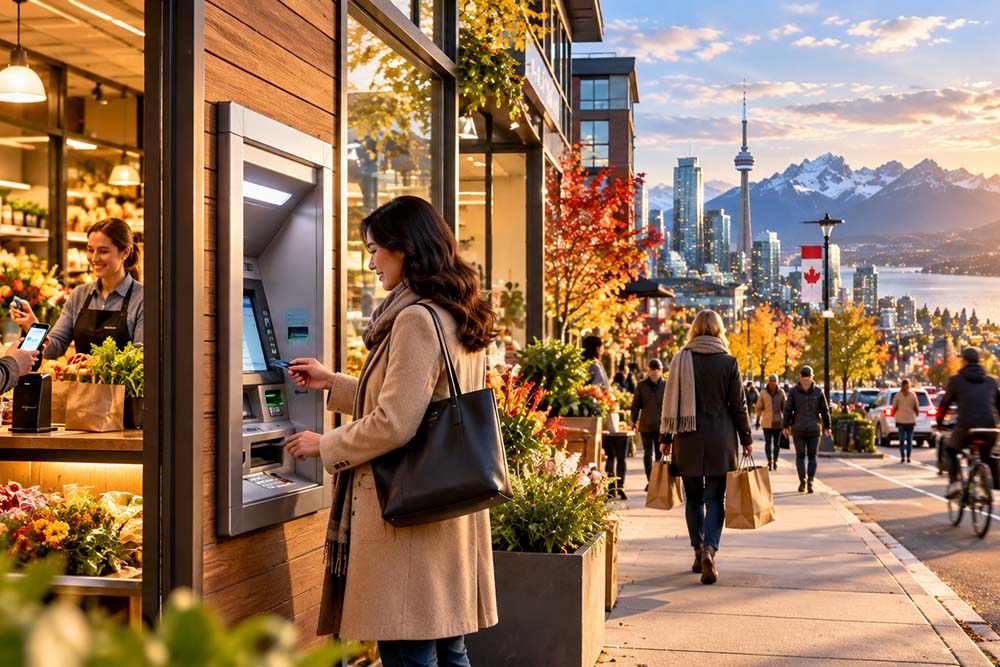


Retail payments have changed quickly. Tap transactions, mobile wallets, online ordering and app-based loyalty programs have made digital payment part of everyday commerce. It would be easy to assume that cash access has become irrelevant. ATMs continue to serve a practical role for customers and merchants because payment behaviour is not uniform, and convenience still depends on giving people options.
Cash has not disappeared from the customer journey
Different customers use different payment methods for different reasons. Some prefer cash for budgeting. Others use it for small purchases, tips, entertainment, personal services or situations where they want a clear spending limit. Certain local businesses continue to see meaningful cash demand even when most transactions are electronic. An ATM meets that demand at the point where the customer needs access, rather than requiring a separate trip to a bank branch.
For merchants, that matters because convenience can influence whether a customer completes a purchase. A consumer who discovers that cash would be useful after arriving at a store, venue or service business may value immediate access more than the payment method itself. The ATM becomes a supporting amenity rather than a competing payment channel.
Placement matters more than assumptions
The business case for an ATM depends heavily on location. Foot traffic alone is not enough. The stronger question is whether the location has genuine “cash intent.” Convenience stores, hospitality venues, entertainment locations, seasonal attractions and businesses with frequent small-ticket purchases may produce very different transaction patterns from professional offices or low-traffic retail sites.
Operators and merchants can evaluate factors such as customer requests, nearby access to bank machines, hours of operation, event traffic and the types of purchases made on site. That information can help determine whether an ATM is likely to solve a real customer need. Good placement is therefore less about installing machines everywhere and more about matching service to behaviour.
The ATM itself has become a managed service
Modern ATM operations are also more data-driven than many customers realize. Remote monitoring can provide visibility into cash levels, communications, transaction status and device errors. That allows operators to organize replenishment and service based on actual conditions instead of waiting for a customer complaint. For a merchant, this can reduce the operational burden of offering cash access.
Security and reliability remain central. The quality of an ATM program depends on compliant processing, secure equipment, proper maintenance and disciplined cash management. A machine that is frequently offline or empty can harm the experience it is supposed to improve. The value comes from dependable access, not simply having equipment on the premises.
Cash access can coexist with digital payments
The most useful way to view ATMs is not as a prediction about whether cash will “win” or “lose.” Retail is moving toward more payment choice, not necessarily one universal method. A customer may tap a phone in the morning, use a card at lunch and withdraw cash later in the day. Businesses that recognize this flexibility can build payment experiences around customer preference rather than ideology.
For retailers, an ATM can also complement a broader payments strategy. Digital acceptance may remain the primary method at checkout, while on-site cash access provides an additional service for customers who want it. The two systems do not need to be in conflict.
The retail economy will continue to become more connected and more digital. That does not automatically eliminate the value of physical access to money. ATMs remain relevant where they reduce friction, support customer choice and operate reliably. Their future is likely to be less about replacing other payment methods and more about filling the gaps that still exist between them.


