


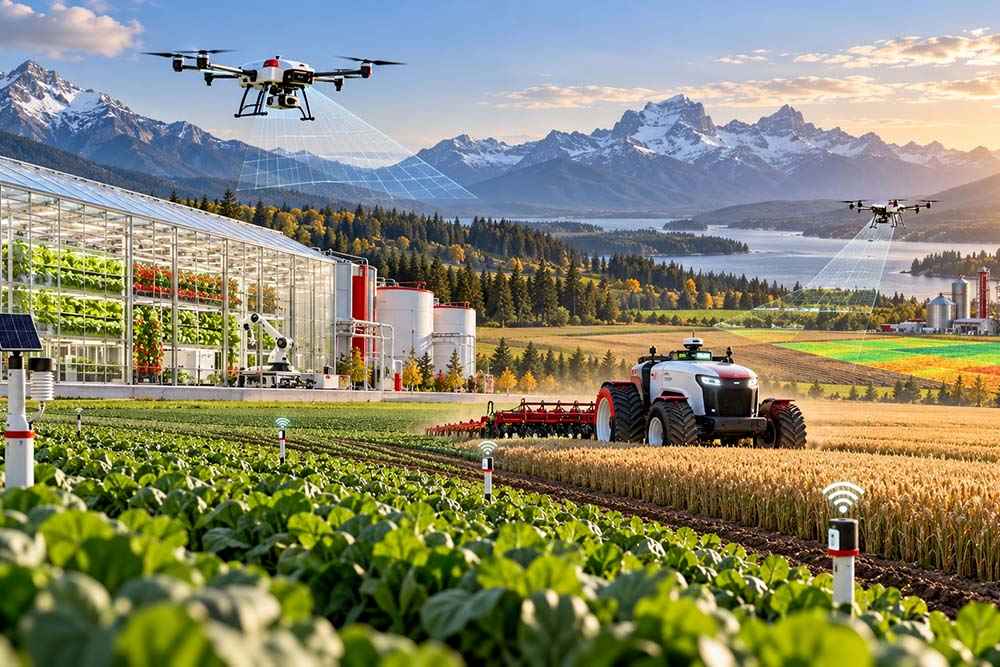

Canada’s food system is often discussed in terms of acres, yields and processing capacity, but the next phase of competitiveness will increasingly depend on information. Farmers, processors and distributors are being asked to produce more consistently while managing labour constraints, input costs, weather volatility and tighter customer expectations. Agri-tech does not remove those pressures. What it can do is make them more visible, measurable and manageable.
From intuition to informed decisions
Agriculture has always relied on experience, local knowledge and timing. Digital tools are adding another layer to that judgment. Soil sensors, satellite imagery, connected equipment and farm-management platforms can help operators see field conditions, track inputs and compare performance across seasons. The key is noticing patterns early enough to act. A grower who understands where water is being used inefficiently, or which fields are developing unevenly, can make a more targeted response instead of applying the same treatment everywhere.
For food processors, the same principle applies inside the plant. Production software, automated inspection systems and connected machinery can give managers a clearer picture of throughput, downtime and quality. When information moves quickly from the production floor to decision-makers, problems can be isolated sooner, and schedules can be adjusted with less disruption. In a sector where shelf life, food safety and consistency matter, better visibility can directly support operational discipline.
Technology is linking the chain
One of the most important shifts is that agri-tech is no longer limited to what happens on the farm. The strongest opportunities appear when information can move across farming, processing, storage and logistics. A processor that has better insight into incoming supply can plan production more effectively. A distributor that can monitor temperature and delivery conditions can reduce uncertainty during transportation. A retailer with stronger demand information can send a clearer signal back through the chain.
This connected model changes the conversation from “Which technology should we buy?” to “Which decision do we need to improve?” That distinction matters. Businesses can easily invest in tools that create dashboards without changing outcomes. A useful technology project starts with a specific operational problem, such as reducing waste, improving traceability, forecasting demand or controlling energy use. The tool should follow the objective.
Adoption will be uneven — and that is normal
Not every farm or food business needs the same level of automation. A large processor may justify robotics and sophisticated analytics, while a smaller operator may gain more from a simple inventory system or digital maintenance schedule. The economics of adoption depend on scale, workforce, product type and existing infrastructure. New systems require clean data, staff training, reliable connectivity and people who understand how to turn information into action.
That is why successful modernization is often gradual. Pilot projects can be more valuable than sweeping transformations. A business can test one use case, measure the operational effect and then decide whether to expand. This reduces the risk of spending heavily on technology that employees do not use, or that does not fit the workflow.
The opportunity is bigger than automation
The future of Canadian food production will not be defined by machines replacing people. It will be defined by businesses using technology to make scarce resources — labour, time, water, energy and capital — work more effectively. That creates room for new skills as well. Equipment technicians, data specialists, food scientists, software providers and operations managers will increasingly work alongside traditional agricultural and processing roles.
For leaders, the practical question is not whether agri-tech will influence the sector. It already is. The more useful question is where technology can remove uncertainty from a decision that matters. Businesses that answer that question clearly can modernize without losing sight of the fundamentals: producing safe, reliable food, protecting margins and serving customers consistently. In that sense, agri-tech is not a separate industry sitting beside agriculture. It is becoming part of how agriculture and food production are managed.


