


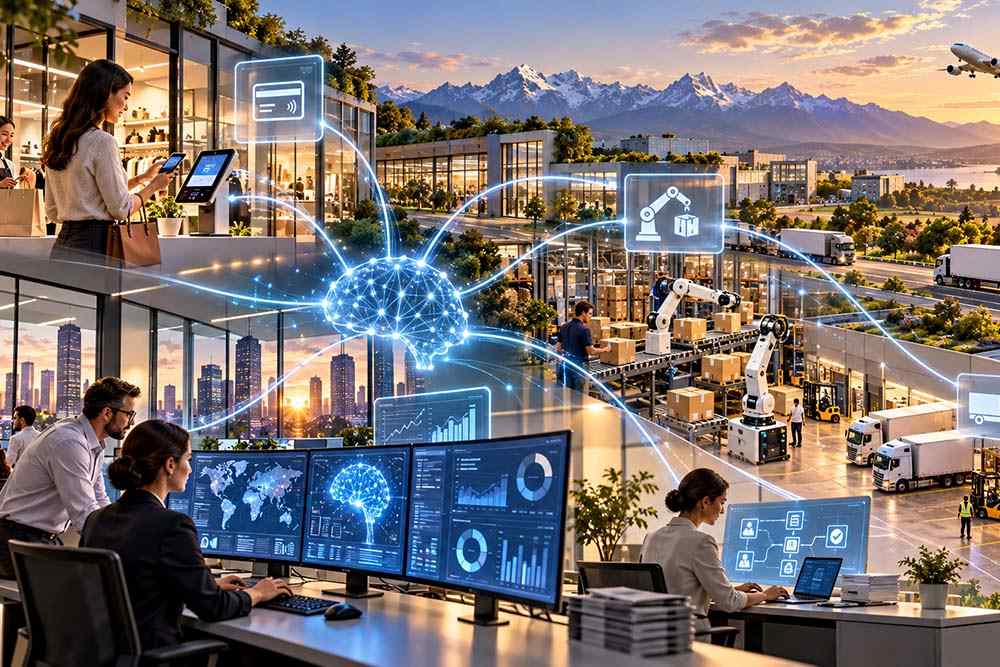


Businesses used to buy technology in separate boxes. Accounting software handled finance. Payment terminals handled checkout. Scheduling tools managed staff. Automation lived in the warehouse or factory. Today, the bigger opportunity is not the capability of each system in isolation but the connections between them. Artificial intelligence, digital payments and workflow automation are beginning to create operating environments where information can move with far less manual effort.
Payments are becoming operational data
A payment is more than money changing hands. It can reveal what was sold, when it was sold, where the transaction occurred and which customer or channel generated it. When payment information connects with inventory and accounting systems, businesses can reduce reconciliation work and gain a faster view of performance.
For a retailer, a completed sale can update stock levels and daily revenue. For a service company, a paid invoice can change the status of a customer account automatically. The value comes from eliminating repeated data entry and reducing the gap between the transaction and the financial record.
Automation removes handoffs
Many business delays occur between systems rather than inside them. An employee exports a spreadsheet, sends an email, waits for approval and then re-enters information elsewhere. Workflow automation can turn those handoffs into rules. A low-stock alert can create a purchasing task. A signed contract can trigger onboarding. A missed payment can generate a reminder.
The best automation projects target repetitive decisions with clear conditions. They do not attempt to automate judgment that depends on context. This distinction keeps systems useful and prevents employees from spending time correcting rules that were too rigid.
AI adds interpretation
Automation follows instructions; AI can help interpret patterns. That can support demand forecasting, customer-service triage, fraud detection, document processing and operational planning. A business might use AI to summarize large volumes of service inquiries, identify unusual transaction activity or forecast which products are likely to need replenishment.
The technology should still operate within defined business controls. AI output can be incomplete or wrong, so companies need review points, clear responsibilities and appropriate data governance. The objective is to accelerate decisions, not outsource accountability.
Connection increases dependency
Integrated systems create efficiency, but they also mean a problem in one area can travel quickly. A payment outage may affect order processing. Incorrect product data may spread across channels. A poorly configured automation can repeat the same mistake hundreds of times. Businesses need monitoring, permissions and fallback procedures that match the importance of the process.
This is why integration should be designed around resilience as well as speed. Teams should know which systems are critical, how data moves between them and what manual alternatives are available during an outage.
The future of business technology is less about collecting more applications and more about building a coherent operating environment. Payments, automation and AI can work together to reduce administrative friction and give managers faster information. But the strongest results come when technology follows a well-understood process. Companies that first simplify the workflow, then connect the systems and finally add intelligence are more likely to create automation that employees trust and operations that can scale.
Governance should grow with automation
As more processes become connected, companies need clear ownership of the rules that drive them. Someone should be responsible for approving changes, reviewing exceptions and confirming that integrations still reflect the business process. Small configuration errors can scale quickly when automation is involved. Simple controls — test environments, change logs, permission levels and periodic reviews — can preserve speed without sacrificing oversight. The more invisible the automation becomes to employees, the more important it is for management to understand who is accountable for it.


