


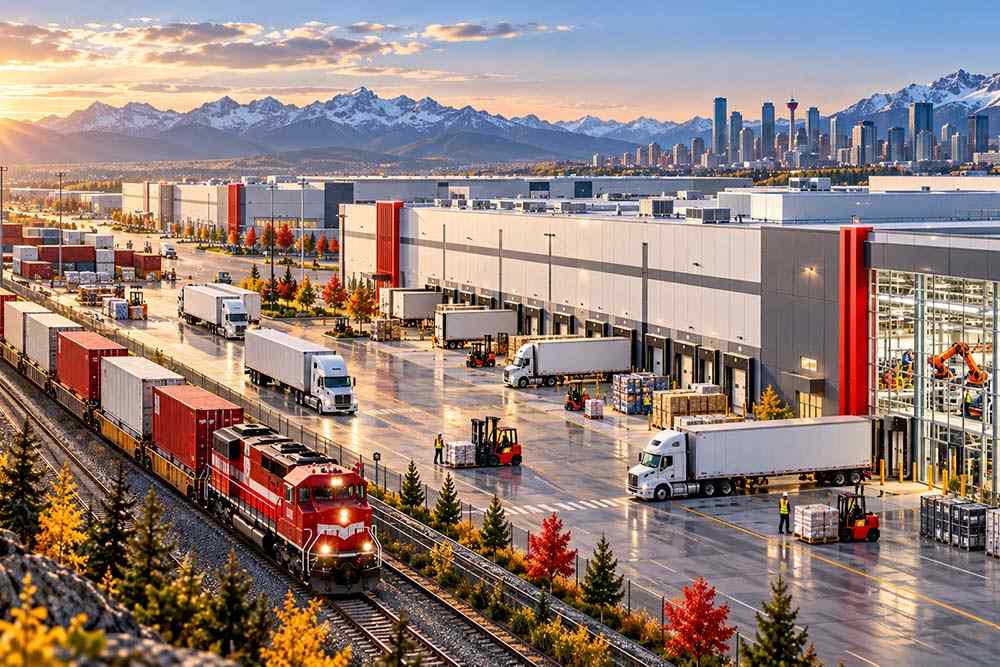


Industrial real estate rarely attracts the same public attention as office towers or residential projects, yet it sits underneath much of the economy’s physical activity. Factories, warehouses, cold-storage buildings, truck yards and distribution centres determine how efficiently companies can make products and move them to market. For manufacturers and logistics operators, the right building is not simply a place to occupy.
The building affects the business model
A company can have strong demand and capable employees, but a poorly matched facility can still restrict growth. Ceiling height, loading access, electrical capacity, floor strength, parking, yard depth and proximity to major routes can all influence what the business is able to do. A warehouse designed for slow-moving bulk storage will not necessarily support a high-volume fulfillment operation. A manufacturing building with inadequate power or limited shipping access can force a tenant to spend heavily before production even begins.
This is why industrial site selection should start with workflow rather than appearance. How does raw material enter the property? Where is it stored? How does it move through production? Where do finished goods wait for shipment? How frequently do trucks arrive? A facility that supports those movements can reduce unnecessary handling and make future automation easier to introduce.
Location is becoming a network decision
Industrial users have traditionally considered highway access and labour availability. Those factors remain important, but the location decision is becoming more connected to the entire supply network. Businesses are weighing access to customers, suppliers, ports, rail, border crossings and regional distribution points. The goal is not always to be closest to the largest city. It may be to find the location that produces the most reliable combination of cost, transportation time and operating capacity.
That can create opportunities outside major downtown markets. Communities with available land, transportation links and a suitable workforce can attract investment when they offer a practical operating case. At the same time, municipalities must balance industrial growth with infrastructure requirements. Roads, utilities, transit and servicing capacity all affect whether new facilities can function at the level companies expect.
Modern buildings are becoming more specialized
The industrial market is also being reshaped by technology. Automated storage, robotics, temperature-controlled systems and advanced manufacturing equipment place different demands on buildings than traditional operations. Power requirements can be higher. Clear heights and column spacing may become more important. Connectivity and backup systems can influence continuity. Even lighting, floor flatness and fire protection can affect what type of automation is possible.
For property owners, this means “flexible industrial space” is becoming more sophisticated. A building that can accommodate multiple business models may command more interest than one designed around a narrow use. Owners who understand the operational needs of manufacturers and distributors can make improvements that are more meaningful than cosmetic renovations.
Expansion requires a real-estate strategy
Growing companies often treat space as a problem to solve only when the current site is full. That approach can create costly urgency. Lease expiries, permitting, construction and equipment moves all take time. A better strategy is to connect the real-estate plan to the company’s growth forecast. If sales increase, what additional storage, production or loading capacity will be needed? Could the existing site be reconfigured? Is expansion space available nearby? Would a second location create operational advantages or simply duplicate overhead?
The answers are different for every business, but the principle is consistent: real estate should be planned alongside capital, staffing and supply-chain decisions.
Industrial property may look like a background asset, yet it directly shapes productivity, customer service and scalability. As Canadian manufacturers and distributors modernize, the buildings that support them will need to modernize as well. The strongest facilities will not be defined only by square footage. They will be defined by how well they enable the work happening inside them.


