


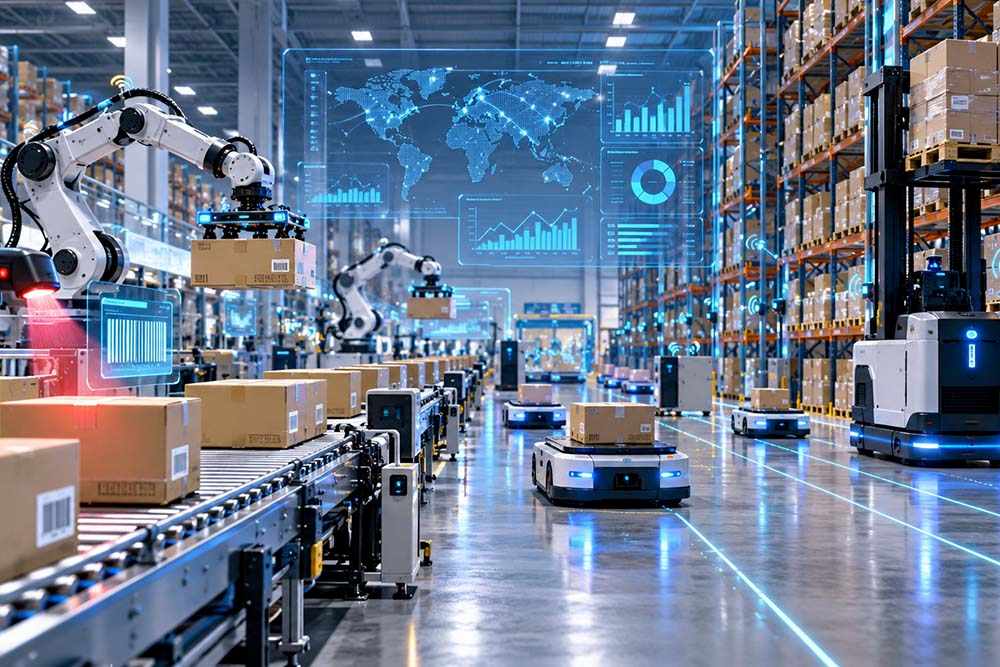


Warehouses were once viewed primarily as storage buildings. Today, many operate as high-speed decision centres where inventory, labour, transportation and customer expectations meet. Robotics and data are changing what a warehouse can do, but the most important transformation is not simply faster machines. It is the ability to coordinate physical work with real-time information.
Automation begins with the bottleneck
The phrase “smart warehouse” can create an image of a fully automated building. In reality, many successful projects are selective. A business may automate repetitive picking, pallet movement, sorting or packaging while people continue to handle exceptions and complex tasks.
If workers spend excessive time walking between storage locations, goods-to-person systems may help. If receiving is slow, scanning and dock scheduling may produce a larger return than robotics. Technology should be applied where it removes measurable friction.
Data changes inventory management
Warehouse-management systems can provide a more accurate view of what is in the building, where it is located and how quickly it moves. That visibility helps businesses improve slotting, replenishment and cycle counting.
Fast-moving items can be positioned closer to packing areas. Slow or seasonal inventory can be stored differently. When inventory accuracy improves, customer service and purchasing decisions can improve as well. The warehouse becomes a source of information for the wider business.
Robotics changes the role of labour
Automation is often discussed in terms of job replacement, but warehouse operations reveal a more complex picture. Robots are well suited to repetitive movement and consistent tasks. People remain important for troubleshooting, quality decisions, maintenance and irregular items.
As automation increases, workforce skills shift. Employees may need to operate systems, respond to alerts and work safely around automated equipment. Training becomes part of the capital investment. A robot that employees do not understand can create new downtime instead of reducing it.
Integration determines whether the building feels smart
A warehouse can contain advanced equipment while still relying on manual spreadsheets between systems. The larger opportunity comes when order management, inventory, labour planning and transportation share information. An incoming order can influence picking priorities; carrier schedules can shape staging; demand forecasts can affect replenishment.
Integration also increases dependency, so businesses need backup procedures and cybersecurity controls. A connected warehouse should be designed for continuity as well as speed.
Smart warehousing is not a destination with one standard design. It is a continuous process of making physical operations more visible and reducing unnecessary movement. Robotics can increase consistency, while data can improve decisions. The businesses that benefit most will be those that resist the temptation to automate for appearance and instead focus on the economics of the workflow. A truly smart warehouse is not defined by how many machines it contains. It is defined by how intelligently people, systems and equipment work together.
The business case should include change management
Warehouse technology affects layout, job roles, maintenance and daily routines. Employees should be involved early enough to explain where the current process creates difficulty and to test how new tools fit the work. This can improve adoption and uncover problems that are not visible in a vendor demonstration. Management should also budget for training, support and process redesign, not only hardware. A successful automation project changes the operating model, and that change requires active leadership.
Design for tomorrow without overbuilding today
Warehouse leaders also need to think about scalability. A system should support future volume without forcing the business to buy every capability immediately. Modular automation, flexible software and layouts that allow expansion can protect capital while keeping options open. The objective is to create a platform that can grow with demand, not a showcase that is oversized for current operations.


