


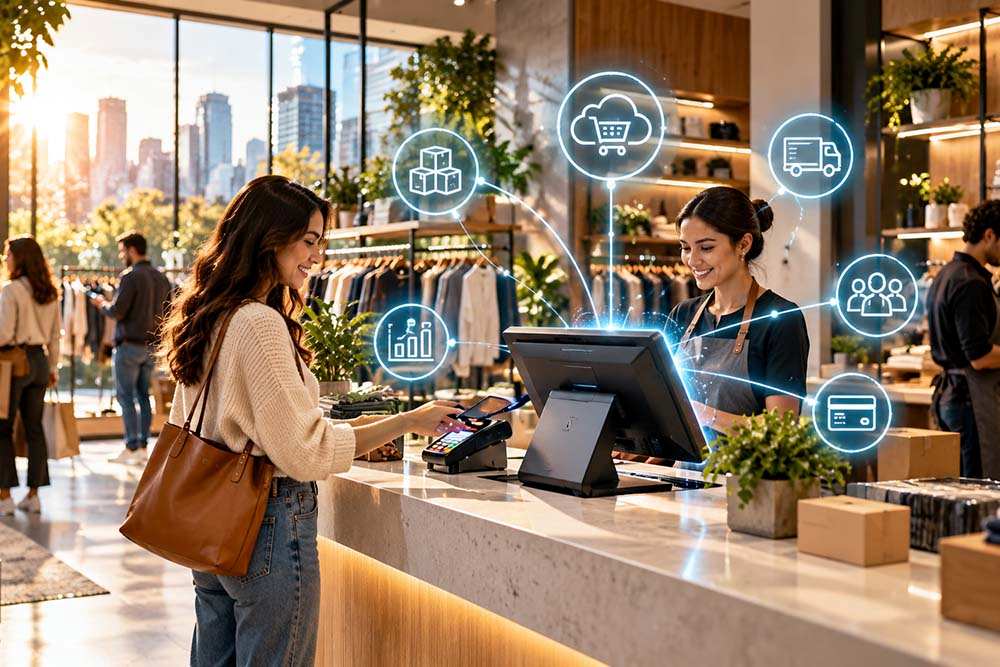

The point-of-sale terminal used to have a narrow job: total the sale, accept payment and print a receipt. That role has expanded dramatically. In many modern retail businesses, the POS sits at the centre of inventory, staff permissions, customer data, loyalty, online orders and reporting. The checkout counter has become a source of operational intelligence.
A transaction now updates the business
When systems are connected properly, a sale can trigger several actions at once. Inventory is reduced. Revenue is recorded. A customer’s loyalty balance may change. A staff member’s activity is logged. Managers can see performance by product, hour or location. The transaction is no longer the end of the process; it is a data point that updates multiple parts of the operation.
This can be especially valuable for multi-location retailers. Instead of waiting for separate reports from each store, owners can compare sales and inventory centrally. A product selling quickly in one location but slowly in another can be identified earlier. Staff access can be standardized. Promotions can be updated across sites without repeating the same manual work.
The best system starts with the workflow
Retailers can be distracted by long feature lists. The better question is how the business actually sells. A quick-service restaurant needs modifiers, kitchen routing and tipping. A specialty retailer may care more about variants, returns and barcode management. A service business may need appointments, deposits and recurring customers.
A POS should therefore be evaluated from the perspective of a normal shift. How many taps does it take to complete a common order? Can staff handle returns without manager workarounds? Does the system make end-of-day reconciliation easier or create additional steps? The answers reveal more than a demo screen.
Payments are only one part of the cost
Processing rates matter, but merchants should also consider software subscriptions, hardware, support, add-on modules and contract terms. A platform that appears inexpensive at the terminal level can become costly if essential functions require multiple paid extensions. Conversely, a higher monthly software cost may be justified if the system replaces separate tools and reduces administration.
The most useful comparison is the total operating cost of a typical month, including the time employees spend managing the system. Retail technology should simplify work rather than transfer it from one screen to another.
Data creates value only when someone uses it
Modern POS platforms can generate extensive reporting, but retailers do not need dozens of dashboards to improve performance. A small set of operational questions may be enough: Which products are gaining momentum? When are the busiest periods? Where are discounts being used? Which items create stockouts? How do locations compare on average ticket or return activity?
When reports are tied to specific decisions, data becomes useful. Managers can adjust ordering, scheduling and merchandising with more confidence. Without that connection, reporting becomes background noise.
The modern POS is evolving into a retail operating hub because it sits where customers, products, staff and payments meet. That position gives it unusual visibility into the business. Retailers should not choose a platform simply because it can do many things. They should choose one that makes the important things easier to manage. The best technology disappears into the workflow, leaving staff with fewer obstacles and management with a clearer view of what is happening across the operation.
Implementation deserves the same attention as selection
Even a capable POS can underperform if the rollout is rushed. Product catalogues need to be cleaned, tax and discount rules tested, staff permissions defined, and employees trained on common exceptions. Merchants should also plan for data migration and decide which reports will be reviewed from day one. A staged implementation can reduce disruption and allow staff feedback to shape the configuration. The objective is not merely to install the software, but to create a system that reflects how the business wants work to happen.


